
May 8, 2026
Why ‘Set It & Forget It’ Is a Risky Strategy for Your Illinois Property
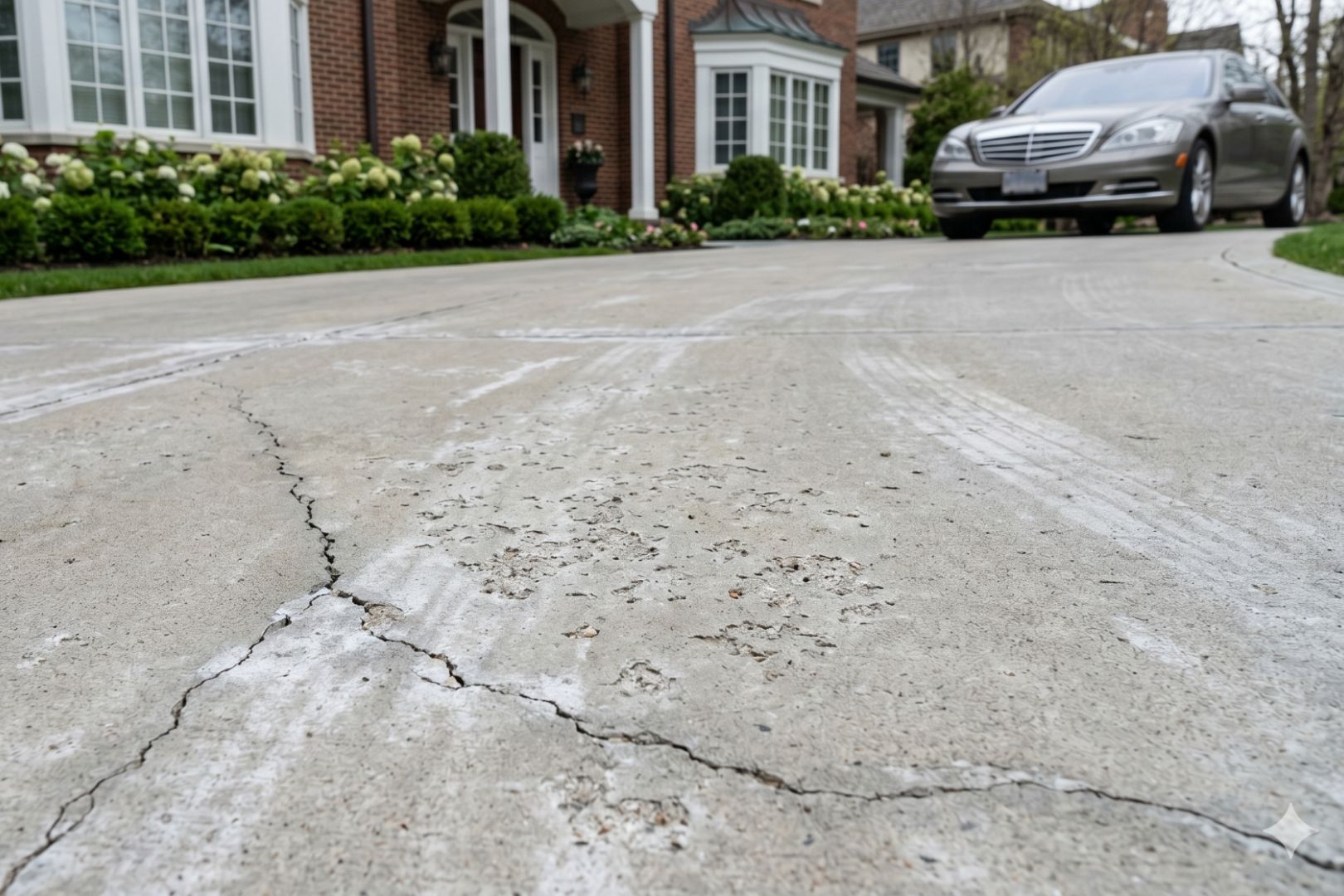
There’s a common misconception among homeowners in Lake and Cook County: once concrete is poured, it’s indestructible for life. The reality is that concrete is a porous material living in one of the harshest climates in the country. Even the highest quality driveways, stoops, and patios require an active defense strategy.
How the Lakeshore Climate Damages Concrete Driveways
If your concrete was installed more than two years ago, or has endured a couple of Illinois winters, your investment has likely taken its first major hits.
Mechanical Wear from Snow Removal
Metal snowplow blades and shovels create micro-abrasions that strip away the concrete’s natural surface protection over time.
The Illinois Freeze-Thaw Cycle
Temperatures in northern Illinois swing constantly around 32°F. When moisture penetrates unsealed pores and freezes, it expands with immense pressure, leading to pitting, scaling, and flaking.
Salt & Chemical Erosion
Salt tracked in from main roads on your tires accelerates the breakdown of the surface paste, leaving concrete dull and vulnerable season after season.
Why Newer Driveways Often Spall Faster Than Old Sidewalks
Homeowners frequently ask: “Why does my newer driveway show scaling while older city sidewalks seem fine after decades?”
It comes down to several key factors.
Modern Residential Concrete Is Finished Differently
Older municipal sidewalks were typically installed with rougher broom finishes that allowed moisture to dissipate more easily than today’s residential installations.
New Concrete Takes Time to Fully Cure
Concrete hardens quickly but continues strengthening long after installation:
- 24 to 48 Hours: Safe for foot traffic
- Approximately 7 Days: Generally safe for passenger vehicles
- 28 Days: Reaches most design strength
- 6 to 12 Months: Continues hardening and densifying
- First 1 to 3 Winters: Most vulnerable exposure period
The first few winters are often the harshest period in a driveway’s entire lifespan.
Today’s De-Icing Products Are More Aggressive
Modern ice melt formulas can be extremely harsh on concrete, especially newer slabs. Even homeowners who avoid applying salt themselves still introduce chlorides via vehicle tires and road runoff.
Safe De-Icing Practices for Illinois Concrete Driveways
No de-icing product is completely harmless, but some are far safer than others.
Recommended Options
- Sand for traction
- Calcium Magnesium Acetate (CMA)
- Treated sand blends
- Products labeled “safe for cured concrete”
Use Sparingly
- Calcium Chloride
- Magnesium Chloride
Avoid Whenever Possible
- Traditional rock salt (Sodium Chloride)
- Ammonium sulfate-based deicers
- Fertilizer-based ice melt blends
Prompt snow removal, minimizing standing water, and periodic cleaning of salt residue can all dramatically extend the life and appearance of your concrete.
Professional Concrete Maintenance: Preservation, Not Repair
Just as you wouldn’t drive a car for years without an oil change, your driveway, patio, and walkways need a sacrificial layer of protection. Our two-step restorative service addresses this directly.
Step 1: Industrial Power Washing
We deep-clean the pores of your concrete, extracting corrosive salts and winter grime that a standard garden hose cannot reach.
Step 2: Surface Restoration & Professional Sealing
When concrete shows early scaling or spalling, we treat entire affected sections rather than isolated spot patches. This maintains visual consistency and prevents further moisture and salt intrusion.
A premium-grade sealer is then applied as a barrier, absorbing the impact from UV rays, salt, and tire friction so your concrete doesn’t have to.
Note: Because concrete naturally varies in color, texture, and age, some variation may remain visible under certain lighting. Full-section refinishing produces a significantly more blended result than localized repairs. The coating may initially appear darker but will normalize as it cures.
Recommended Concrete Maintenance Schedule for Lake & Cook County Homeowners
First Year After Installation
Avoid harsh de-icing chemicals, minimize standing water, and remove snow promptly.
Every 2 to 3 Years
Reapply penetrating sealer as needed and deep-clean accumulated chlorides and contaminants.
After Severe Illinois Winters
Inspect for scaling, surface dulling, flaking, joint separation, or early spalling activity.
Don’t Wait Until It’s Too Late: Contact Total Paving & Brick Services Today
Addressing small surface issues early is far more cost-effective than allowing freeze-thaw damage to progress. Proactive cleaning, sealing, and early surface restoration can dramatically slow deterioration and help preserve both the appearance and structural integrity of your investment.
If your driveway, patio, stoop, or walkways are showing signs of wear after this past winter, our team is ready to help.
